Guest Lectures in the course: ?Die Aufteilung der Erde – Eine Imperialismusgeschichte“
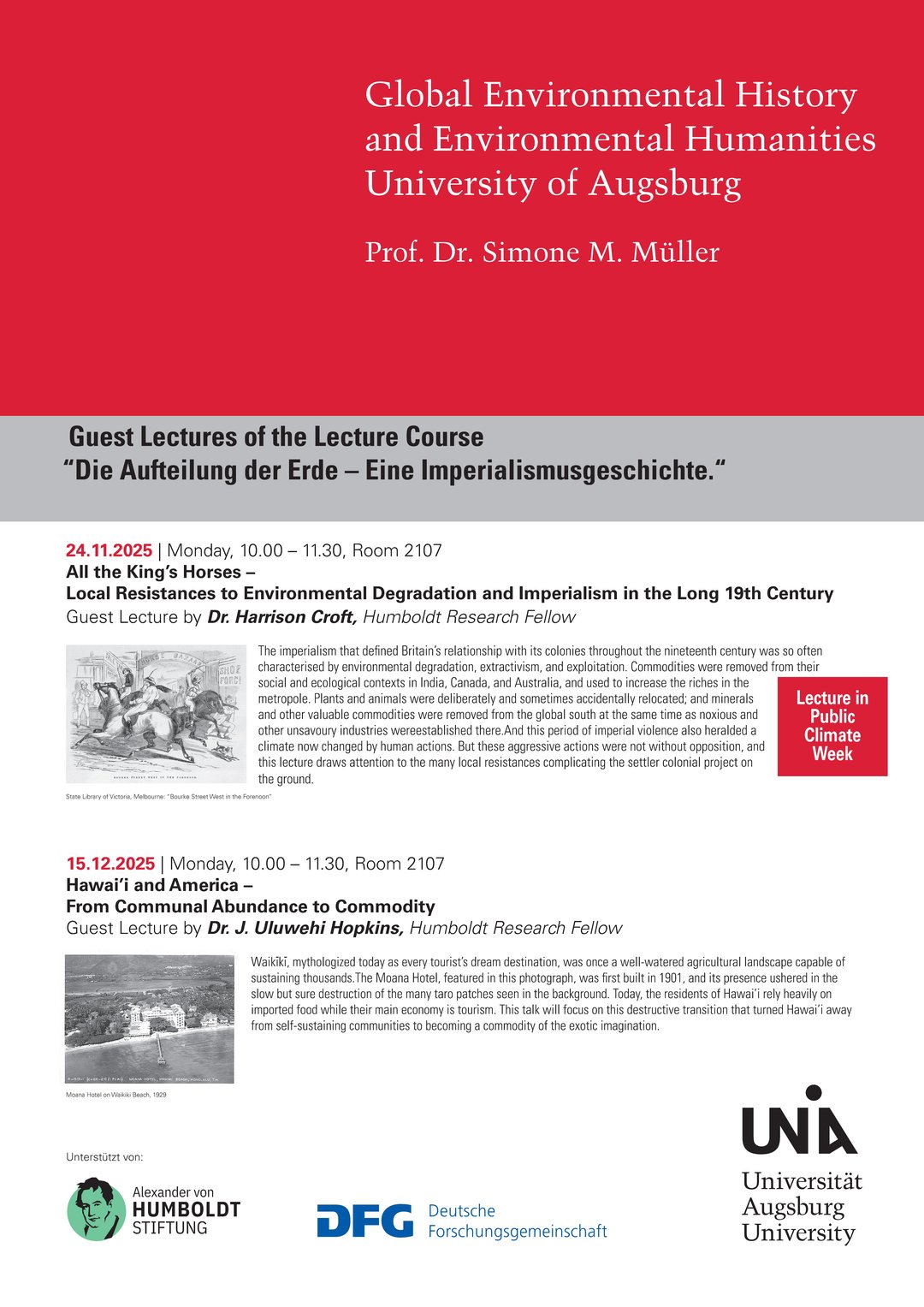
As part of the lecture series by Professor Simone M. Müller, there will be guest lectures by Dr. Harrison Croft (24.11.2025, Public Climate School) and by Dr. J. Uluwehi Hopkins (15.12.2025). The lectures will take place on Mondays from 10:00 to 11:30 in Lecture Hall 2107 in Building D. Anyone interested is welcome to attend. The lecture of Dr. Harrison Croft (Humboldt Research Fellow) “All the King’s Horses – Local Resistances to Environmental Degradation and Imperialism in the Long 19th Century” deals with local resistance movements in the colonies against British imperialism. The imperialism that defined Britain’s relationship with its colonies throughout the nineteenth century was so often characterised by environmental degradation, extractivism, and exploitation. Commodities were removed from their social and ecological contexts in India, Canada, and Australia, and used to increase the riches in the metropole. Plants and animals were deliberately and sometimes accidentally relocated; and minerals and other valuable commodities were removed from the global south at the same time as noxious and other unsavoury industries were established there. And this period of imperial violence also heralded a climate now changed by human actions. But these aggressive actions were not without opposition, and this lecture draws attention to the many local resistances complicating the settler colonial project on the ground. ? Dr. J. Uluwehi Hopkins’ (Humboldt Research Fellow) will use her Lecture ?Hawai’i and America – From Communal Abundance to Commodity“ to talk about her home Hawai’i and about its forced transformation from self-sufficient communities to an import-dependent tourist hotspot. Waikīkī, mythologized today as every tourist’s dream destination, was once a well-watered agricultural landscape capable of sustaining thousands. The Moana Hotel, featured in this photograph, was first built in 1901, and its presence ushered in the slow but sure destruction of the many taro patches seen in the background. Today, the residents of Hawai’i rely heavily on imported food while their main economy is tourism. This talk will focus on this destructive transition that turned Hawai’i away from self-sustaining communities to becoming a commodity of the exotic imagination. ?